


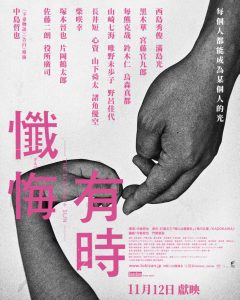
The Brightest Sun: a whodunit that dissolves into a haunting study of parenthood
The Brightest Sun begins as a murder mystery and ends as something far harder to name. A corrupt private detective is found dead; two investigators—burnt-out Satake (Hidetoshi Nishijima) and raw trainee Satoko (Hikari Mitsushima)—are sent to reconstruct his final case. The trail leads to a disabled boy who vanished nine years earlier and to the man who took him in and raised him in secret: an act the law calls abduction and the film quietly insists on calling love. That is the pivot on which everything turns, and Nakashima handles it with enough clarity that the shift never feels like a cheat. What seemed a puzzle becomes a reckoning.
The “four families” are less discrete households than four wounds bleeding into one another. Satake’s disabled son has died; his wife Yuki (Ko Shibasaki) is in a psychiatric facility, and his teenage daughter resents parents who poured everything into a brother who is gone. Tamie (Haru Kuroki) was told by her husband that their disabled child would have been better off unborn; when the boy was taken, she did nothing. Satoko is estranged from her daughter after stabbing her abusive husband—an act her child witnessed and understood, perhaps too clearly, as rage rather than protection. And there is the guardian whose crime is inseparable from his devotion, his motives tangled with everyone else’s need to atone. The acting is excellent across the board. Nishijima plays Satake as a man held together by whisky and silence, his dead-fish expression a kind of armour. Mitsushima is the film’s restless heart, all messy feeling and forward motion. Kuroki makes Tamie’s detachment almost unbearable, while Shibasaki’s brief, glassy presence lingers. Koji Yakusho brings weary gravity to the agency boss, and Kankuro Kudo’s quietly broken turn is a reminder of how good he is when he underplays.
At 130 minutes the film never loosens its grip. Nakashima’s fractured editing—funeral, corpse, bar, memory, all interrupting one another—creates the sensation of lives that cannot be straightened out. Yuma Koda’s score is crucial: piano and synthesiser lines hovering between lament and lullaby, with track titles such as “Repent”, “Miserere” and “Lamb” signalling quiet, unconsoled grief. It never tells you how to feel; it refuses to let you look away.
This is also recognisably the work of the director of Kamikaze Girls, Memories of Matsuko, Confessions and The World of Kanako. Nakashima has always set surface dazzle against a cold gaze at family failure: the maximalist colour and musical numbers of his earlier films, the multi-perspective revenge of Confessions, the father’s search curdling into nihilism in Kanako. The Brightest Sun is being received as a change in tone—restraint, a noirish grey palette, his first feature in seven years—but the continuity is stronger than the shift. The non-linear, multi-perspective architecture remains; information arrives in fragments and refuses a clean verdict. The fast associative editing is still there, now serving a sombre rhythm. And the obsession is unchanged: what happens when care fails, and how failure is passed on. Here he strips away the ironic distance and asks the question plainly. It is not a departure but a maturation—the same diagnostician of familial damage, now willing to sit with the pain rather than stylise it.
The Brightest Sun is not a film that solves anything. It sits with the unbearable question of whether a life should have begun at all, and finds, in the asking, a terrible tenderness.
Elven Ho